
What Is the Debt-to-Income Ratio Required for a Mortgage in NC?
What Is the Debt-to-Income Ratio Required for a Mortgage in NC?
How DTI works, what the limits are by loan type, and the three-step calculation every Charlotte buyer should do before applying.
Your debt-to-income ratio is the percentage of your gross monthly income that goes toward monthly debt payments. It’s one of the two most important numbers in any mortgage application, alongside your credit score. Lenders in North Carolina use DTI to determine how much mortgage you can responsibly afford. Here’s exactly how it works.
The Two DTI Ratios Lenders Use
Front-end DTI (housing ratio): This is just your proposed monthly housing costs divided by your gross monthly income. Most conventional lenders want this at 28% or below. FHA allows up to 31%.
Back-end DTI (total debt ratio): This is all your monthly debt payments, including the new mortgage, divided by your gross monthly income. This is the number that usually makes or breaks an approval.
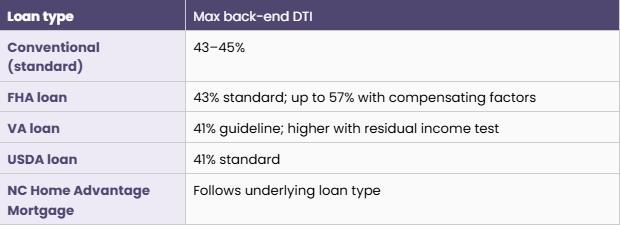
The Three-Step DTI Calculation
Here’s how to calculate your own DTI before you ever talk to a lender.
Step 1: Add up all your current monthly debt payments. Include car loans, minimum credit card payments, student loan payments, personal loans, and any other recurring obligations. Do not include utilities, groceries, subscriptions, or rent.
Step 2: Calculate your gross monthly income. This is your pre-tax income divided by 12. Include base salary plus consistent overtime, bonuses with a two-year history, and any other verifiable income sources. If it’s variable income (bonuses, side hustles, etc), the lender will not count it unless it’s been an income source for 2 years or more.
Step 3: Divide your total monthly debts (including your estimated new mortgage payment) by your gross monthly income. Multiply by 100 to get a percentage. That’s your DTI.
Example: $70,000 income = $5,833/month gross. Monthly debts: car $350, student loan $280, credit card minimum $75 = $705. Estimated mortgage payment (principal, interest, taxes, insurance, PMI): $1,800. Total monthly obligations: $2,505. DTI: $2,505 / $5,833 = 43%. That’s right at the conventional limit.
A 43% DTI gets you approved on paper. A 36% DTI gets you approved with options. There’s a meaningful difference between qualifying and qualifying well. The lower your DTI, the better rate you’ll be offered and the more breathing room you have in your monthly budget.
What Counts and What Doesn’t
Lenders count:
Car loans
Student loan payments (or imputed amount if in deferment)
Credit card minimum payments
Personal loan payments
Child support or alimony obligations
Any installment debt with more than 10 months remaining
Lenders do not count:
Rent payments
Utilities, cell phone, subscriptions
Groceries, gas, entertainment
Voluntary retirement contributions
Insurance premiums not included in the mortgage payment
This means two people with identical salaries can have very different DTIs based on how much installment debt they carry. The person with the paid-off car and low credit card balances qualifies for significantly more house.
How to Improve Your DTI Before Applying
Pay off small balances: Eliminating a $150/month credit card minimum costs less upfront than you might think but moves your DTI meaningfully.
Increase your income: Lenders can count consistent overtime and side income with a two-year documented history. If you’ve been doing freelance work for two years, it can count.
Increase your down payment: A larger down payment reduces your loan amount and therefore your estimated monthly mortgage payment, lowering your back-end DTI.
Target a lower purchase price: Sometimes the honest answer is that a $320,000 home puts you in a healthy DTI range while a $400,000 home doesn’t. That’s not a compromise. It’s a smart first step.
DTI is a calculation, not a verdict. I’ve seen buyers walk into the process thinking they don’t qualify, run the numbers with a lender, and find out they’re well within range. I’ve also seen the reverse. Either way, knowing your number before you start touring saves everyone time and heartbreak.
Want to run your DTI before you talk to a lender? Reach out at 828.575.6067 or [email protected]. I can walk through the math with you and connect you with a lender who will give you straight answers.
Laura Shinkle
Charlotte’s First-Time Homebuyer Specialist | Realtor®
Coldwell Banker Realty | Licensed in NC & SC
CREN | PSA | CLHMS Certified
📲 828.575.6067 | 📧 [email protected]