How Much Do I Need to Make to Buy a House in Charlotte, NC?
How Much Do I Need to Make to Buy a House in Charlotte, NC?
A real look at the income math, with actual numbers for 2026.
The short answer: most financial guidelines suggest spending no more than 28% to 30% of your gross monthly income on housing. At Charlotte’s current median home price of around $425,000, you’d generally need a household income in the range of $90,000 to $110,000 to buy comfortably at that price with a conventional down payment. But that number shifts a lot based on your down payment, your existing debt, and what loan program you use. Here’s how to actually think through it.
The Basic Income Math
Lenders use two ratios to determine what you can afford. The front-end ratio is how much of your gross monthly income goes toward housing costs, including principal, interest, taxes, insurance, and HOA if applicable. Most conventional lenders want that at 28% or below. The back-end ratio is your total monthly debt, which includes your mortgage plus car payments, student loans, credit cards, and other recurring obligations. Lenders typically want that at 43% or below, though FHA loans allow up to 57% with compensating factors.
Let’s run the actual math at Charlotte’s median price.
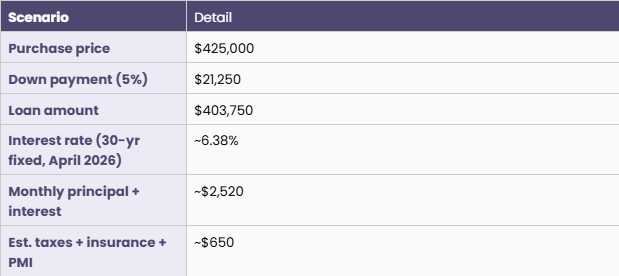
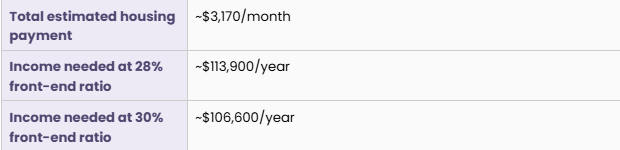
Those numbers assume a 5% down payment with PMI. Put 10% down and your monthly payment drops by roughly $150 to $200, which also lowers the income threshold. Or a loan program with no PMI can also change those numbers.
These are guidelines, not hard ceilings. I’ve helped buyers qualify at income levels below these figures by using down payment assistance to reduce their out of pocket costs, or by paying down debt first to improve their DTI. The math is always more flexible than it looks on paper.
What If You Have Debt?
This is where the calculation gets personal. If you’re carrying a car payment, student loans, or credit card minimums, those eat into what a lender will approve for your mortgage. Here’s the three-step DTI calculation that actually matters:
Step 1: Multiply your gross monthly income by 43% (the maximum back-end DTI most lenders allow).
Step 2: Subtract your total existing monthly debt payments from that number.
Step 3: What’s left is the maximum monthly mortgage payment a lender will approve.
Example: $80,000 annual income is $6,667/month gross. At 43% DTI, your total monthly debt ceiling is $2,867. If you have $600 in existing monthly debt (car payment + minimum credit card payments), you have $2,267 left for a mortgage payment. At today’s rates, that supports a loan of roughly $300,000 to $320,000, not the $400,000 you might have assumed.
This is why paying down debt before buying can change the math dramatically. Eliminating a $300/month car payment adds roughly $40,000 to $50,000 in borrowing power.
Lower Income Options That Actually Work
Charlotte has programs that change the math for buyers who don’t hit the $100K+ income threshold.
FHA loans: Require only 3.5% down with a 580+ credit score, which significantly lowers the cash needed upfront and the income required to close.
HouseCharlotte program: Provides up to $10,000 in down payment assistance for buyers earning up to 110% of the area median income. Less cash needed at closing means a smaller loan, which means a lower monthly payment.
NC Home Advantage Mortgage: Offers up to $15,000 in down payment assistance statewide. Income limit is $152,000. This is one of the most overlooked programs in the state.
NC 1st Home Advantage: A fixed $15,000 specifically for first-time buyers and veterans, structured as a 0% interest deferred second mortgage.
100% financed options: There are several lending options available that have no PMI payment, and don’t require a down payment. Yes, the interest rate will likely be higher to make up for the added risk from the bank, but it’s an option to get you into a property and start earning equity. And no PMI? Game changer.
Combining a lower down payment loan with assistance programs can put homeownership within reach at incomes well below the numbers in the table above. I’ve seen buyers close on Charlotte homes with household incomes in the $55,000 to $65,000 range by using the right combination of programs.
I bought my first home at 22 on a single income. The number that almost stopped me from starting was the one I had in my head, not the one that was actually true. The first step is always figuring out your real number, not the one you’ve assumed.
The Honest Bottom Line
For a median-priced home in Charlotte around $425,000 with a conventional loan and minimal existing debt, you’ll generally need household income in the $90,000 to $115,000 range depending on your down payment. For less expensive homes in the $300,000 to $350,000 range, that threshold drops to $70,000 to $90,000.
Your actual number depends on your debt, your credit score, your down payment, and which loan program you use. The only way to know your real number is to get pre-approved with a professional who looks at your full financial picture, not just your salary. And no, the online calculators don’t count as a professional.
Ready to find out your real number? Reach out at 828.575.6067 or [email protected]. I’ll connect you with a trusted local lender and walk through what the math actually looks like for your situation.
Laura Shinkle
Charlotte’s First-Time Homebuyer Specialist | Realtor®
Coldwell Banker Realty | Licensed in NC & SC
CREN | PSA | CLHMS Certified
📲 828.575.6067 | 📧 [email protected]